Composting
Age-old and topical
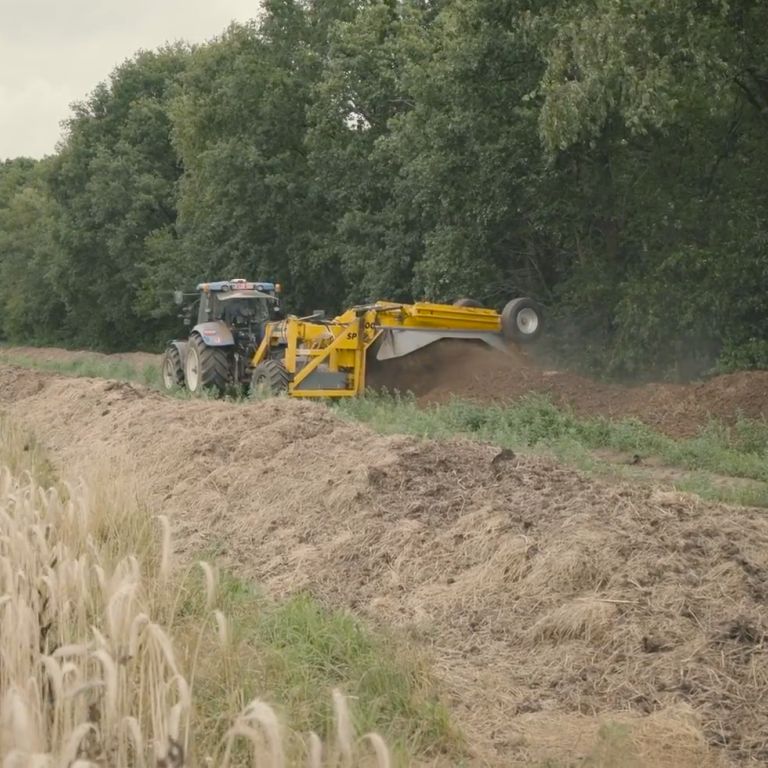
Compost is a dark, almost black, crumbly substance made from organic matter that can be used as a fertiliser and soil improver. Compost is the result of natural decomposition, a rotting process. These natural processes have been occurring for millions of years in the layers of leaf litter in forests. Here, bacteria, fungi, and various microorganisms break down fallen leaves, twigs, and branches, converting them into nutrients for the soil. These nutrients are slowly released, feeding plants and trees. Composting is the accelerated and controlled execution of that natural process.
For the "Water & Land" project, the Centre for Agricultural History and the Dutch Intangible Heritage Knowledge Centre collaborated with farmers, researchers, and supporting organizations on composting. While not traditionally considered intangible heritage, composting has a long history and encompasses a wealth of traditional knowledge. Moreover, (farm) composting has been gaining renewed attention in recent years. This is reason enough for us to seek new insights into this centuries-old agricultural practice.
Download here the brochure 'Composting: forgotten knowledge, new futures'

Composting is centuries old. From the Roman period to the present day, compost has been used in various forms, and the so-called "compost heap" was known by various names in Dutch: smoorhopen, teerhopen, mesthopen, smooraarde, teeltaarde, smoringen, karsel ... Whatever the name, Flemish and Dutch farmers used their own organic waste for centuries to nourish crop-depleted soil.
"Our ancestors seem to have had a real predilection for making arable manure from all kinds of organic waste, sludge, and other rich soil. These were called smoorhopen, smooraarde, smoringen, or karsel (a kind of compost heap)" – Lindemans, History of Agriculture, part 1, p. 68
In the 1920s, composting became scientifically understood, and attention to soil biology grew. The ecological movement responded to the rise of chemical fertilisers and posited that agriculture should be organic and ecologically sound. The development and adaptation of composting to an increasingly mechanical process in Europe proceeded slowly in the 1930s and 1940s. Competition with other waste processing methods, such as incineration, an established waste management method, further slowed the development of composting. After World War II, the motto "Nooit meer honger" (never hunger again) was paramount, with enormous changes, specialisation, scaling up, and mechanisation in agriculture. Artificial fertilisers also became a significant factor in the agricultural industry. This breakthrough of artificial fertilisers pushed composting further into the realm of biodynamic and ecological agriculture, leading to the technique's limited application. However, composting remained present in the niche of biodynamic and ecological agriculture, and new techniques were developed. From the 1980s and 1990s, , the processing of green waste and kitchen waste boomed in Flanders and the Netherlands, pushed composting out of its niche. Research into composting techniques took place, composting machines were developed, and large-scale composting facilities were built. All of this contributed to the revival of compost in vegetable and ornamental gardens, as well as amongst farmers, especially those focused on organic or regenerative agriculture.
I think that knowledge from the past is of immense value. Before us, farmers had come to know this landscape and its soil, for generations. We will certainly take that with us. We also look at historical maps, for example. These show how a landscape was structured in the past, often through very conscious choices. Farmers knew where it was wet, where there was a dry spot, and where it was best to plant their orchard
– Iris Claessens, Nature-inclusive farm 't Sierveld

Using compost was, and remains, a technique of great value for agriculture and horticulture. It is simultaneously a soil improver, fertiliser, a circular economy, and a climate solution. As an ancient agricultural practice—and a form of intangible heritage—composting offers many opportunities for ecological sustainability, soil health, and climate adaptation. Compost increases the organic matter content in the soil, improves soil structure, and thus improves water infiltration and reduces erosion. Compost promotes more active soil life, counteracts acidification, and prevents soil dehydration. It also provides slow-release nutrients, such as nitrogen and phosphorus, which also give compost valuable fertilisation value.
Healthy soil is crucial for all these soil functions, from food production and the source of raw materials to water management, the biological habitat, and the gene pool. Healthy soil also acts as a sponge, retaining water during dry periods and producing healthier (food) products. However, a large amount of our soil is in an unhealthy state, physically, chemically, and biologically. To restore the soil, we must work long-term.
Unfortunately, going from good soil quality to poor soil quality is a very quick and easy process. Conversely, restoring poor soil quality to good quality is often a long-term process.
- Annemie Elsen, Bodemkundige Dienst België

To restore our soil to health, practices like composting can help. Composting has been gaining traction and increased in use in recent decades. At home, in gardens, or vegetable patches. At large composting facilities, which have delivered high-quality compost since the separate collection of organic waste. And at farms, where farmers are starting to use farm composting. Whether working on a large or small scale, composting requires attentive senses and knowledge of compostable materials to achieve a good end-product. In addition to the important role of the senses, innovative technologies, insights, and mechanization all work together to achieve the same principle: applying organic waste to improve the soil. By collaborating with farmers, horticulturalists, composters , nature organizations, managers, and policymakers on research and regulations, a future for (farm) composting can be guaranteed.
And the future?
In today's fast-paced, technological, and urbanized society, old knowledge about composting often disappears. Competition from artificial fertilizers, alternative techniques, and waste processing methods, gradually saw composting relegated to a niche practice by farmers and gardeners just a few decades ago. This led to an erosion of knowledge, with all the associated consequences for our soil. Fortunately, composting is once again gaining in importance, and fragments of remaining knowledge are being supplemented by new research. These old agricultural practices are indeed worthwhile to safeguard and maintain, as they often make significant contributions on a small scale, but they also preserve knowledge that can potentially be applied on a larger scale.