Educational past
Knowledge from the past for solutions today
During the "Soil" theme year, CAG and KIEN collaborated with the composting heritage community to explore sustainable applications, focusing primarily on the heritage character of this practice. The opportunities are significant, but so are the challenges. To leverage this intangible heritage as a lever for climate action, four key areas of focus are identified.
1. Need for a change of mentality
The current cultural landscape is the result of thousands of years of interaction between natural processes and all kinds of human development. Over the past century, we have increasingly and radically shaped the landscape to our liking, assuming that nature can be manipulated. However, we are now reaching the limits of that idea, with all its consequences. Our soil is becoming depleted and is increasingly struggling to cope with climate extremes.
A shift in our approach to the landscape is necessary. From the idea that our environment can be shaped, back to living with and in the landscape, and with attention to the importance of ecosystem services. For many intangible heritage practices, the link with ecosystem services is not an obvious one. A practice like composting, while perhaps not an obvious intangible heritage practice, has already often been described as such, based on the ecosystem services it provides. In this case, it might be interesting to highlight cultural ecosystem services and thus outline a holistic vision. For example, the fact that composters possess a source of knowledge, that they are engaged in an outdoor activity in a green work environment while composting, is important for cognitive development and enrichment, among other things, and can play a role in a necessary shift in mentality.
I think that knowledge from the past is of immense value. Before us, farmers had come to know this landscape and its soil, for generations. We will certainly take that with us. We also look at historical maps, for example. These show how a landscape was structured in the past, often through very conscious choices. Farmers knew where it was wet, where there was a dry spot, and where it was best to plant their orchard.
– Iris Claessens, Nature-inclusive farm 't Sierveld
2. Co-production as a key word
Heritage communities can add valuable local insights to knowledge about climate and environmental change. However, looking to the past isn't always a given for policymakers or watercourse and landscape managers. Therefore, co-production is essential: by involving various parties and knowledge systems from the outset in the development of policy and management plans or management agreements, a broader and more robust policy is created.
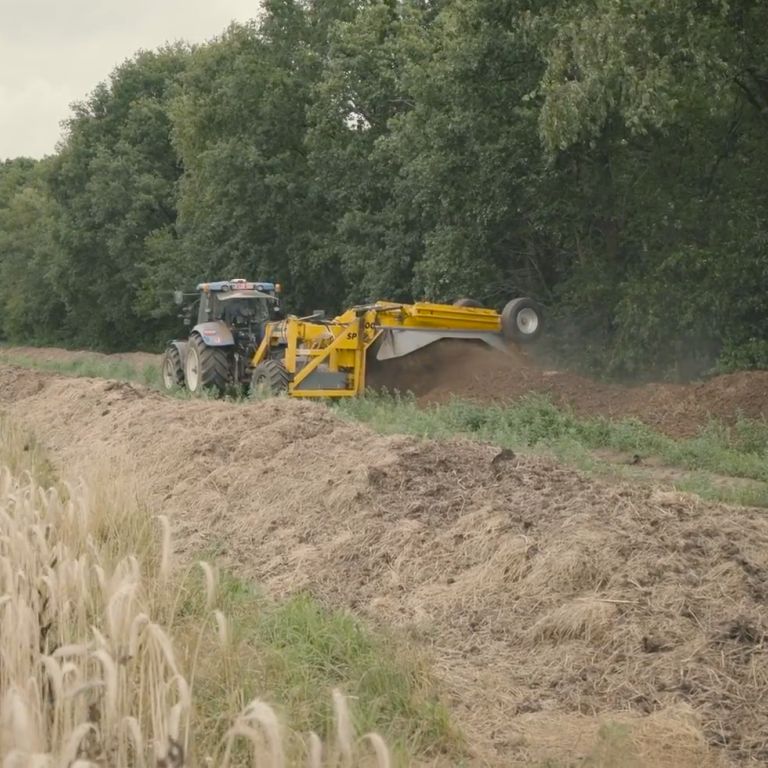
Composting offers significant opportunities for collaboration, combining waste streams and sharing a soil-improving end-product. By incorporating the knowledge and practical experience of farm composters into the development of regulations is a key example of how coproduction can facilitate the future of composting.
Establishing networks and contacts is a key recommendation for achieving co-production. By incorporating local knowledge into regulations and guiding frameworks, through collaboration and knowledge sharing, practices like (farm) composting can be facilitated.
3. Need for policy and good examples
The link between sustainable development and heritage still receives insufficient attention. CAG and KIEN want to raise awareness among policymakers, professionals, and the public about the importance of this connection. In the case of composting, numerous projects and programs already emphasize the importance of soil health and practices that contribute to it, without an explicit focus on heritage or much attention to the sensory aspects of composting. Moreover, several examples already exist within the Flemish government that demonstrate a growing awareness of soil health.
These kinds of projects and programs are crucial, partly because they can provide legal exemptions for examples like on-farm composting, thus enabling pilot projects without policy adjustments. On the other hand, they are invaluable because they demonstrate that it can work in practice, and therefore a facilitating legislative framework is necessary.
Many farmers are interested in our residual flows for farm composting. However, we currently lack the legal framework, which is being worked on very hard behind the scenes to ensure it's realistic for farmers and also realistic for us.
- Wim Dirckx, Natuurpunt
4. Substantiate with research
If we aim to incorporate intangible heritage or long-standing knowledge into adaptation strategies, and policies of the future, more research is needed. Other practical examples from the Water & Land project involved investigating the sustainability claims of intangible heritage. In the case of composting, the focus is more on historical research into practical application. A great deal of agricultural, biological, and ecological research is already being conducted on composting, especially on-farm composting. Moreover, researchers are already working intensively with farmers to gather knowledge in this area.
Sharing knowledge from farmer to farmer is important. Scientists can certainly contribute significantly to this by better understanding: 'What's happening here, and why is it working here and not there?'
– Jeroen Watté, Regenerate4Resilience
History also offers us specific ideas about how we can adapt to a changing environment. Research into the changing ecosystem services of the landscape also teaches us how the landscape and our interactions with it evolved.
Conclusion
Integrating intangible heritage into development, management, policy, and research requires a new way of thinking. It challenges conventional thinking and established values. Looking back at and drawing inspiration from the past can also be valuable for our soil fertility. Without in-depth scientific knowledge, people already knew how to care for our soil. Today, this "intimate knowledge" (as UNESCO calls it) can be substantiated by scientific research and high-tech development. To achieve this, collaboration is crucial: between farmers, between agriculture and nature, agriculture and (historical) research, and so on. Important steps are already being taken in this regard. Composting is one example of a soil-improving practice, but there are numerous other ways to improve our soil health, or even be more broadly interesting in the context of climate adaptation and mitigation. Intangible heritage of water and land has shaped the landscape for centuries. Let's ensure it continues to play a leading role in the future.