Report: Workshop on Living Heritage, ecological sustainability and climate action

Living Heritage, Ecological Sustainability and Climate Action – Workshop Report
Can traditional irrigation, transhumance or water mills really point us toward a climate-smart future? That surprising connection emerged in Leuven, where CAG and KIEN gathered experts from ten countries to explore water, soil, and biodiversity through the lens of living heritage.
“This workshop proved the power of bringing very different heritage specialists and researchers around one table,” said prof. dr. Yves Segers, coordinator of CAG and ICAG. “I am convinced that our meeting in Leuven is only the first step toward many new and inspiring collaborations.”
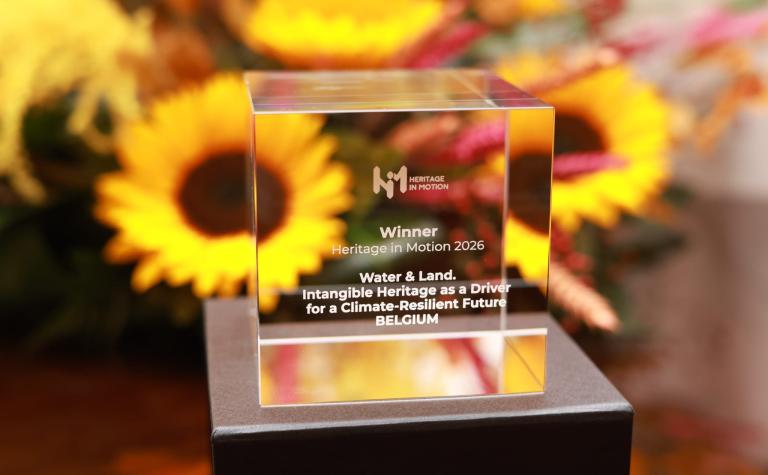
After a warm welcome from KU Leuven’s Vice-Rector for Sustainability, Gerard Govers, the two-day workshop opened with the key findings of Water & Land, the three-year partnership between the Centre for Agrarian History (CAG) and the Dutch Centre for Intangible Cultural Heritage (KIEN). Our research showed how heritage practices can help raise groundwater levels, lock carbon in soil, improve local biodiversity, and inspire citizens to engage actively and responsibly with their landscapes. The potential of intangible heritage for climate adaptation, mitigation and biodiversity is great, but so are the challenges.
Following this overview, Danielle de Vooght (Head of Research Support, KU Leuven) presented new funding opportunities, highlighting many avenues for further research, networks, and collaborations.
Water management
From gravity-fed canals in Provence to stone watermills in Basilicata, the first afternoon explored how communities still draw climate-smart solutions from water systems engineered centuries ago.
Jacopo Trivisonno opened with a case study on Italy’s Fortore Valley, where the Occhito Dam impacted local communities, ecological systems and cultural landscapes. Today, participatory tools such as a ‘lake contract’ offer ways to reimagine the dam’s future.
In a pre-recorded presentation, Aurélie Condevaux took participants to southeastern France, where recognising the gravity-fed irrigation as intangible heritage has empowered local irrigators and validated the practice as a drought adaptation strategy.
Maria-Carmela Grano demonstrated how mapping more than eight hundred stone watermills in Basilicata provides valuable insights into historical knowledge of erosion, sedimentation and water risk.
Deniz Ikiz, in another pre-recorded presentation, examined the Dutch Polder system of Waterland, north of Amsterdam, and the efforts to transplant the same model to 17th-century Batavia (now Jakarta). Her analysis showed that copying physical infrastructure without its collaborative governance culture can actually heighten flood risks.
Finally, Zuzanna Sliwinska added a critical perspective, highlighting the tension between preserving World Heritage landscapes and adapting to new realities in times of climate change.
These presentations, all focused on water practices, revealed several recurring themes. First, collaboration between heritage communities, public authorities, water managers, and researchers is crucial. Second, traditional ecological knowledge remains an untapped opportunity at many levels of government. And third, research is vital: both into traditional practices and into the history and evolution of landscapes, emphasising the dynamic interaction between people and place.
Forgotten knowledge, experimental research, and local climate indicators
Friday’s sessions shifted from flowing water to living ground, yet the logic of participation and cooperation remained central.
David Fontán Bestilleiro and Roque Sanfiz Arias demonstrated how Galicia’s Laboratorio Ecosocial do Barbanza shows diversification of land uses based on historic common-land practices such as grazing reduces wildfires.
Leen Vansteenkiste introduced new participatory design methods in Belgian Limburg, walking-in-soil and working-in-soil, to explore human-soil relationships across the width and depth of the large-scale project area, as well as cooperation between humans and more-than-humans.
Claus Kropp’s research of ploughing historic ridge-and-furrow fields revealed a system of risk minimization. It increased field surface area, created different microclimates in one field balancing yield regardless of weather extremes, and helped with erosion control. This historic agricultural practice represents resilience mechanisms that may well be relevant today and in the future.
After the break, Ioana Baskerville and Julio Sa Rego presented comparative research on transhumance in Romania and Portugal, its socio-environmental benefits, and connected rituals. They highlighted the need to holistically investigate cultural practices closely tied to grassroots economic activities, practices that remain understudied due to research paradigms that often disconnect the spiritual from the material.
Toni Kraljić and Tamara Nikolić Đerić presented two Croation forest management techniques (drmun and trikanje) which support biodiversity, prevent wildfires, curb invasive species, enhance climate resilience, and most of all embody local identity.
Duje Mikelić from NGO 4 Grada Dragodid closed the session with Still Water Revival, a Croatian project that restores dry-stone walls and ponds, not only reviving biodiversity, but also reignited local appreciation for the stone-masonry heritage as a living, practical part of landscape stewardship.
These cases revealed how forgotten or overlooked knowledge holds local solutions to global challenges.
Not only were the technical aspects and the effect of traditional techniques in climate adaptation underlined as important, but at least as important was the connection with the land, the ‘power of place’ and a feeling of ecocitizenship, the social connection of the members of the community involved, and the feeling of happiness this invokes. Also, the knowledge and experiences of communities about their changing (local) environment offers opportunities to map climate change locally, as local indicators for climate change impact. The workshop underscored the need to see intangible heritage as a whole and document both cultural, economic and practical factors of traditional ecological knowledge.
Policy frameworks
The Friday afternoon session began with two presentations on viticulture. Jasmin Jalil explained the practice of cultivating the head-trained bush vine on the island of Pantelleria and its positive impact on water conservation, soil protection, biodiversity preservation and microclimate management. She highlighted that some principles are scalable or can be transferred to other situations, which shows another side of the potential that our ICH carries.
Jenny Herman followed with a critical view on the limits of terroir-as-heritage in European viticulture. Systems such as the French AOC label show a blending of nature and agriculture into economic and cultural policy that results in place-based connections that are at risk due to climate change and regulations. Farmers are unable to respond to real- time conditions and biodiversity loss due to monocultures hidden under the heritage label, among others, calls this terroir logic into question.
The final presentation of the workshop was given by Leena Marsio, who reported about the LIVIND project and drew everyone’s attention to the fact that sustainability has other dimensions than ecological sustainability alone. The LIVIND project looked at the interconnectedness of ICH and the four aspects of sustainability (cultural, social, ecological and economical) inspired cooperation between participating countries and regions and provided policy recommendations on ICH as a resource.
The discussions highlighted a fragile balance between heritage and commercialization, regulation and opportunity, and the need for more trained professionals in the field and possibilities in education and internships. Priorities included long-term, local engagement, identifying and researching, and raising awareness about ICH. This could help identify what and when to safeguard, when to adapt, to change the function of an element of intangible cultural heritage but keep the meaning.
Connecting the dots
By the end of the workshop, canals, soil, sheep and cattle, vines and forests converged on one message: past forward. Ecological functions and intangible heritage can reinforce each other, creating robust systems for facing today's climate challenges. Recurrent themes such as cooperative governance and place-specific design resonated across Europe’s varied geographies.
Beneath a diversity of practices, the conclusions of the Water & Land project seemed to reoccur in one way or another.
A mentality shift, from static preservation to dynamic stewardship capable of absorbing climatic uncertainty and biodiversity loss.
Participatory practice and co-production of knowledge, placing community expertise alongside scientific inquiry.
Policy innovation, re-engineering regulatory and fiscal instruments to move best practices from pilot projects to mainstream action.
Cross-sectoral and holistic research integrating ecological, cultural and social dimensions to capture the full spectrum of benefits and trade-offs.
New insights and plans
“Throughout the workshop I was struck by the parallels between Flemish hedge-layers from our Water & Land project, Galician commoners and Croatian dry-stone wallers,” said Laura Danckaert. “Their practices differ, yet they all show that intangible heritage can be a building block for climate resilience when seen as forward-looking knowledge rather than backward-looking folklore.” That insight, noted Chantal Bisschop of CAG, reflects an international shift. “Intangible heritage, ecological sustainability and climate change are now high on UNESCO’s agenda. With Water & Land, we proved the relevance of this subject. Bringing researchers from across Europe to Leuven to exchange results, gain fresh perspectives and sketch plans is immensely valuable and will only strengthen our future work on this theme.”
From the Dutch side, Jet Bakels found the workshop energizing. “It was encouraging to assemble so much expertise in Leuven; and the topic is firmly on KIEN’s agenda.” Her colleague Susanne Bergwerff looks ahead with optimism: “The workshop felt like the start of something new. When historians, anthropologists, practitioners, and architects share the table, inspiration emerges quickly. We are ready to build on these connections and work together to embed heritage in tomorrow’s climate strategy.”