Contactday Water & Land
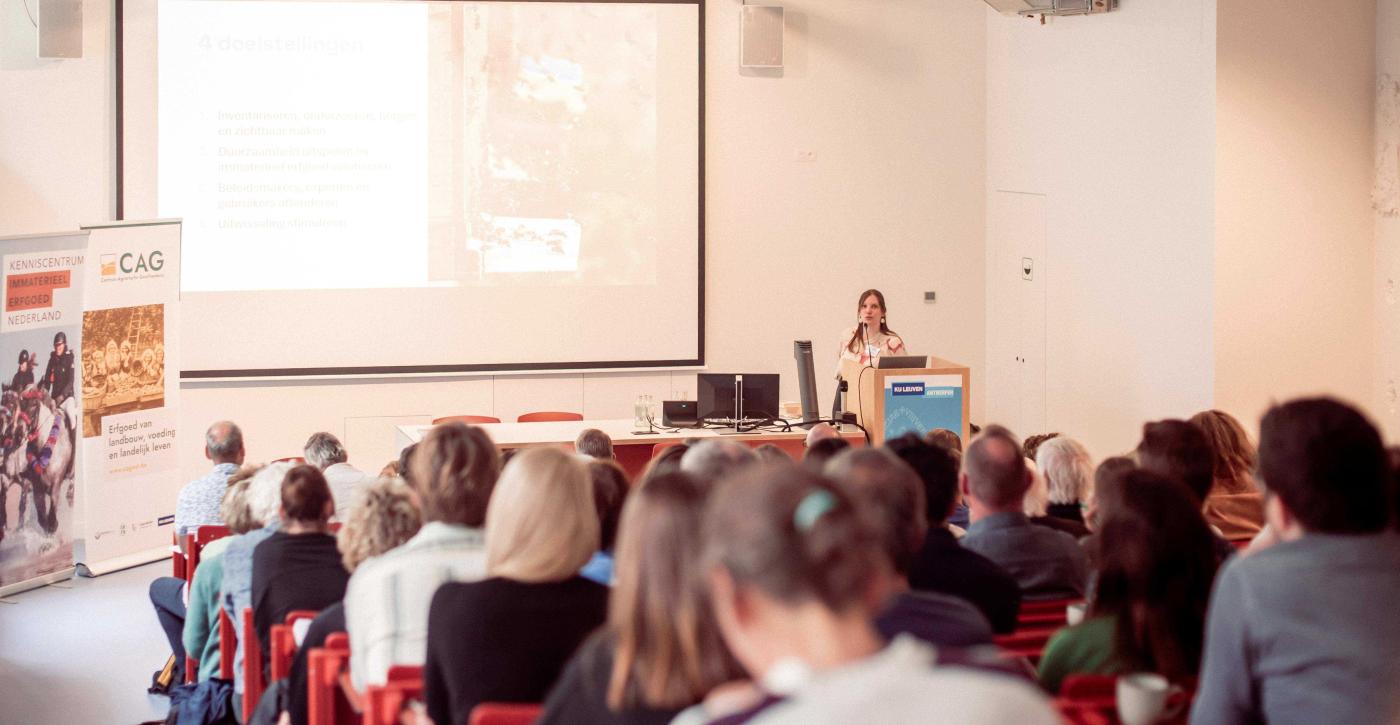
On 3 October, CAG and the Dutch Centre for Intangible Cultural Heritage (KIEN) brought together heritage workers, landscape managers, researchers and practitioners from Flanders and the Netherlands in Antwerp for the Water & Land contact day. Three years of collaboration culminated in an inspiring day full of encounters, reflection and new perspectives.
Looking ahead
The main results, insights and experiences from “Water & Land” took centre stage, but at the same time, the focus was on what is yet to come. After all, the potential for incorporating intangible heritage into sustainable landscape management is far from exhausted. On the contrary, “Water & Land” showed how many opportunities there are to interweave heritage knowledge and practices with the challenges of climate and landscape.
This desire to build further was evident throughout the programme, from the premiere of the documentary “Water & Land. Intangible heritage as a driver for a climate-resilient future” to the fascinating contributions of the speakers, who each explored the connection between heritage, landscape and climate change from their own area of expertise.

A warm welcome
The participants gathered in the beautiful Campus Opera building for a day of meetings and exchanges. In the Atrium, the video reports by Water & Land provided an atmospheric introduction, immediately setting the tone for the discussions and the curious energy that would characterise the day. Lode Roels (VRT) kept everything running smoothly as host and moderator.
The morning began with a warm welcome from Yves Segers, coordinator of CAG, and Saskia Van Oostveen, director of KIEN. They looked back on the fruitful collaboration between the two organisations and emphasised how important it is to further embed the knowledge and networks that have been built up in the heritage field.

Centuries-old geo-heritage
Professor dr. Gert Verstraeten (KU Leuven) opened with an insightful keynote speech on the formation of Flemish valley areas over the centuries. He showed how natural and human processes have shaped the landscape, and how traces of earlier periods are still visible today in soil layers and relief.
His message was clear: anyone working on nature restoration must also be mindful of this valuable geo-heritage. An interdisciplinary and holistic approach – with attention to geophysical, ecological and cultural-historical processes – is essential in this regard.
The Water & Land project
After the first keynote speech, it was time for the presentation of the Water & Land project. Laura Danckaert (CAG) explained how Water & Land investigated how intangible heritage can serve as a lever for climate adaptation and mitigation. She illustrated how knowledge and traditions from the past can inspire contemporary challenges, and how collaboration between heritage workers, policymakers and communities is crucial to making that translation.
The highlight of the morning was the premiere of the documentary 'Water & Land. Intangible heritage as a driver for a climate-resilient future'. Based on the practices studied – from traditional irrigation to composting – and with insights from Ignace Schops (Regional Landscape Kempen and Maasland) and Gertjan de Boer (Cultural Heritage Agency of the Netherlands), the film shows the many connections between heritage, climate and social resilience.
After the documentary, Laura Danckaert continued her presentation with a reflection on three years of Water & Land and the most important insights from the pilot project.
- A change in mentality is needed: heritage is not static and a source of obstruction, but a source of solutions.
- Co-production and collaboration are essential – from kitchen table discussions to cross-policy partnerships.
- Good examples are crucial for the necessary policy adjustments: pilot projects deserve every attention in this regard.
- Supporting interdisciplinary research translates the sustainable claims of intangible heritage into hard evidence.

In dialogue: heritage, policy and practice
In an in-depth panel discussion, Tim Soens (University of Antwerp), Riet Meijer (Hooydonkse Watermolen) and Gertjan de Boer (Cultural Heritage Agency of the Netherlands) reflected on the project and looked ahead to the future. There is certainly support for heritage as a lever, provided that the added value is made tangible.
The panellists emphasised the importance of further research – from historical maps and geological data to research into functional interweaving – in order to continue to strengthen the link between landscape and heritage. In a densely populated area such as Flanders and the Netherlands, with ever-decreasing open space, drawing inspiration from historical landscapes is not self-evident, but it is extremely valuable. Cooperation is essential here: start informally, continue structurally.
The heritage sector must play an active role in this as a bridge builder, was the unanimous opinion. Together with ambassadors in other sectors, we must position heritage as part of the solution, not as an obstacle, even if this sometimes requires customisation, creativity and realism. The panellists concluded on a realistic note: many heritage practices are labour-intensive and scaling up is not always feasible. The key, therefore, is to find ways in which our heritage can inspire us and be translated or adapted to current challenges.

UNESCO: intangible heritage and climate adaptation
As vice-chair of the Flemish UNESCO Commission, Jorijn Neyrinck placed the project in an international context. She linked Water & Land to global trends such as the growing attention for UNESCO Man & Biosphere areas – with Kempen~Broek as the first Belgian-Dutch area – and UNESCO's activities in, for example, a Guidance Note on intangible heritage and climate change. Jorijn highlighted the Water & Land project as a driving force at various levels: Flemish, Dutch and international.

Keynote by Jan van der Ploeg
After lunch, Dr Jan van der Ploeg (Van Hall Larenstein) took us to the South Pacific, where he emphasised the importance of local communities and their Traditional Ecological Knowledge (TEK). His message was familiar: knowledge and practices are location-specific, but the challenges are universal.
Even on the other side of the world, it is abundantly clear that these local knowledge systems must be valued. However, local communities cannot do it alone, and some (climate) threats are so great that a so-called “renaissance” of local nature management is not a panacea. Problems surrounding the scaling up of these kinds of local, sustainable practices and continuity in nature conservation projects are important issues in the South Pacific as well as in Flanders and the Netherlands.
Parallel sessions: in-depth discussion and interaction
We then delved deeper into specific themes in three working sessions:
Session 1 – Integrated collaboration on climate-resilient (water) heritage
Contributions from Eric Brinckmann (Het Lankheet), Jan Bastiaens (Agentschap Onroerend Erfgoed) and Patrick Golkowski (Watering De Dommelvallei) showed how historical water management systems do not offer ready-made solutions, but can inspire contemporary climate challenges. Maps and data, such as watermeadow maps, help to translate historical knowledge into future-oriented solutions.
Session 2 – Mapping and registering green heritage
Els Oostvogels (Regionaal Landschap Kleine en Grote Nete), Kathleen de Clercq (Hogeschool PXL) and Lex Roeleveld (Heg & Landschap) investigated how green heritage practices can be preserved, what impact they have on biodiversity, and what role heritage communities play in this.
Session 3 – Looking ahead: follow-up research on intangible heritage and climate change
Susanne Bergwerff (KIEN) and Gertjan de Boer (Cultural Heritage Agency of the Netherlands) took a closer look at how climate change affects our heritage. Joris Relaes (ILVO) explained how the Institute for Agricultural and Fisheries Research is primarily concerned with the future of agriculture and how technology can be used in a smart way, but nevertheless also increasingly (re)discovers the importance of tacit knowledge. In the discussion that followed, there was a call to transcend pigeonholing and policy domains and a plea not to engage in ideological “battles” but simply to take action: “Forward to the basics!”.

Future
The “Water & Land” contact day made it clear that this is a highly topical issue. The many positive reactions, new contacts and ideas exchanged show that there is a willingness to continue working together and explore new avenues.
The knowledge gained, the many collaborations and the shared inspiration form a solid foundation for the future. Together, we will continue to build a heritage initiative that connects people and landscape, past and future.