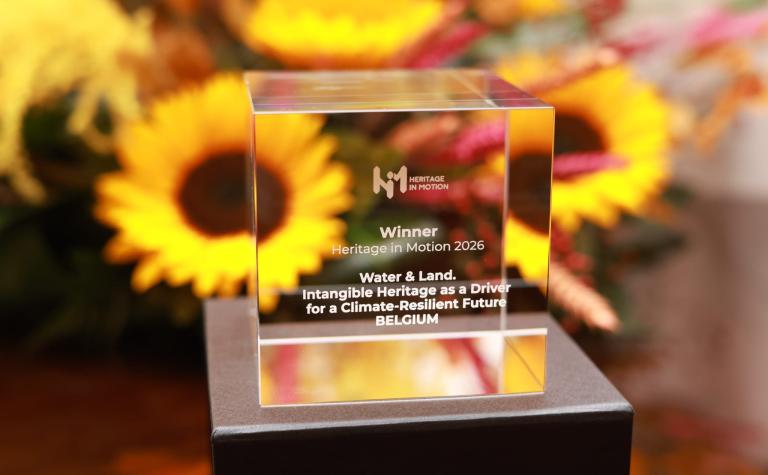
Water & Land wins two awards at Heritage in Motion 2026
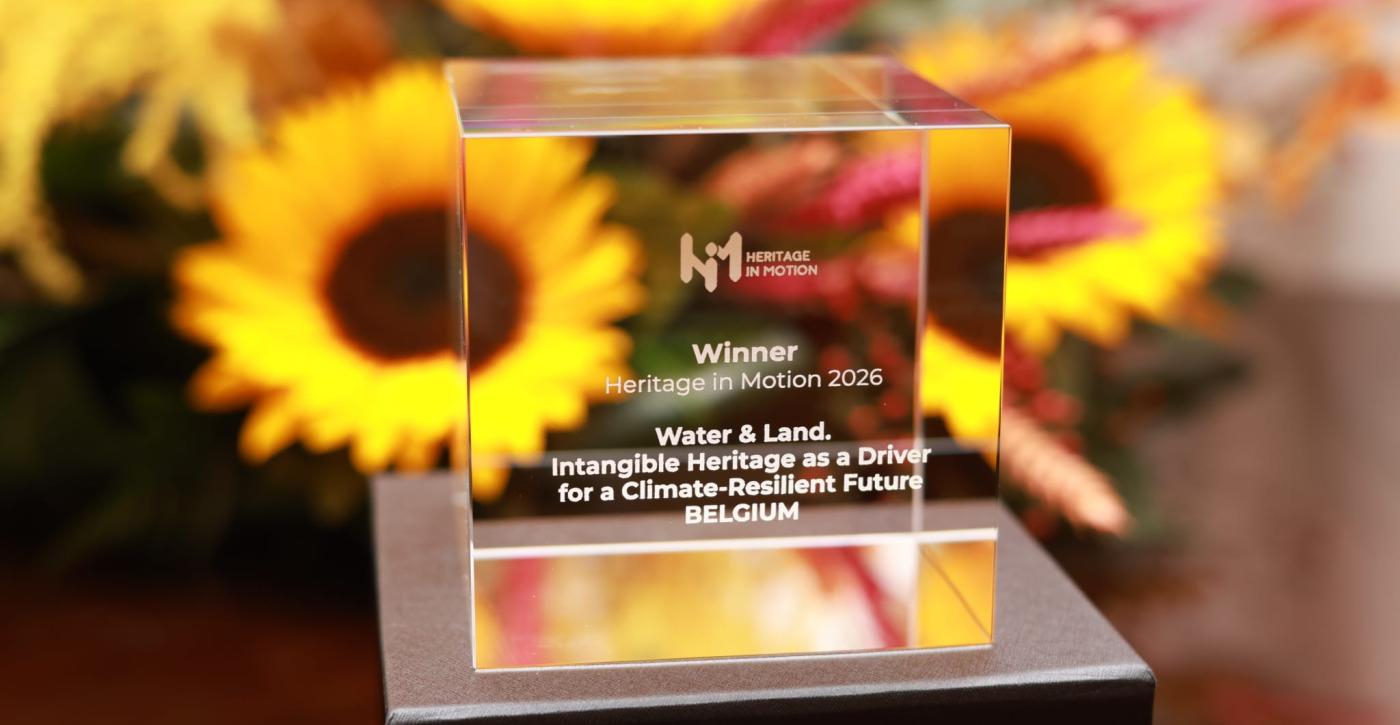
The Heritage in Motion Awards were presented in Bled, Slovenia, on September 30. The documentary *Water & Land: Intangible Heritage as a Driver for a Climate-Resilient Future* won the ‘Audiovisual Heritage’ category and was also named the ‘Overall Winner’ of Heritage in Motion 2026. The documentary was produced through a collaboration between the Centre for Agrarian History (CAG), the Dutch Centre for Intangible Heritage (KIEN), and filmmaker Joris Gijsen (Willem Tel).
Heritage in Motion annually recognizes the most innovative digital, multimedia, and audiovisual projects related to cultural heritage in Europe. The award is organized by the European Museum Academy, the Forum of Slavic Cultures, and the Bled Culture Institute—this year, for the first time, in partnership with Museums in Short. More than thirty projects from nineteen countries competed. The eighteen finalists presented their work at the Heritage in Motion Festival, held in Bled on September 29 and 30. The range of entries was remarkably diverse, spanning VR, AR, and XR applications, interactive experiences, and film.
Beauty and urgency
The international jury praised the film for "the rare way it combines beauty and urgency." “This is documentary filmmaking at its best: interwoven with the landscape, generous in how it portrays people and their knowledge, and deeply relevant to the challenges of our time. A film that reminds us why heritage matters and what it can still teach us,” the jury stated.
*Water & Land* won the award in the Audiovisual Heritage category because the film “clearly and sensitively demonstrates how living heritage can be a powerful response to climate change.” By connecting traditional knowledge, local communities, and ecological resilience, the film shows—according to the jury—that heritage is not merely about preserving the past; it can also inspire action and help build a climate-resilient future.
“Honestly? We didn’t expect a film about hedge-laying and composting to make the cut alongside VR and interactive installations,” says Chantal Bisschop, staff member intangible heritage at CAG. “But perhaps that is precisely the message. The answer to the climate crisis doesn’t always lie in something new. Sometimes it lies in knowledge that has been in people’s hands for centuries—knowledge we need to learn to see anew. The fact that an international jury has recognized this gives us, and the communities we work with, a tremendous boost.”
Knowledge in minds and hands
The world often looks to new technology for the answer to the climate crisis. Water & Land looks in a different direction: toward farmers, landscape managers, heritage practitioners, and volunteers who have been employing sustainable practices for generations. In Belgium and the Netherlands, they demonstrate how practices such as meadow irrigation, water mills, hedge laying, and composting continue to hold ecological, cultural, and social value today. Ignace Schops (Director of Regionaal Landschap Kempen & Maasland and Chair of Bond Beter Leefmilieu) and Gertjan de Boer (Cultural Heritage Agency of the Netherlands and Chair of the Climate and Heritage platform) place these practices in a broader context. Methods tested over centuries are proving useful for climate adaptation and biodiversity restoration.
The documentary marks the culmination of Water & Land: Intangible Heritage and Sustainable Development, a three-year international pilot project (2022–2025) led by CAG and KIEN with support from the Flemish government. Each year focused on a different challenge: water management, biodiversity, and soil fertility. In addition to the documentary, the project produced eleven short films, ten podcasts, and five brochures. The project had already won awards previously: in 2024, Water & Land won the Ultima in the Movable and Intangible Heritage category—the Flemish Culture Prize for outstanding cultural achievements. On that occasion, too, the jury particularly praised the close collaboration with heritage communities. With the two awards in Bled, this Flemish recognition is now gaining an international dimension.
Filming living heritage means filming people
The documentary is the result of intensive collaboration with heritage communities. “When you film living heritage, you’re filming people,” says project coordinator Laura Danckaert (CAG), who wrote the script together with filmmaker Joris Gijsen (Willem Tel). “We didn’t want to make a film about heritage communities, but with them. They reviewed various versions, were able to make adjustments, and the footage belongs to them just as much as it does to us. So, this award also belongs, in part, to everyone who was willing to share their knowledge with us on camera.”
“People working on climate adaptation usually sit at the table with engineers, ecologists, and policymakers—rarely with the beekeeper, the miller, or the hedgelayer who know the landscape so well. For us, this award serves primarily as an argument: those people and their knowledge belong at that table,” concludes Susanne Bergwerff of KIEN.
Watch the film
You can watch the documentary online here. You can find all the project's short films, podcasts, and brochures on the Knowledge page.